
Geoblocking: why you cannot see some content online
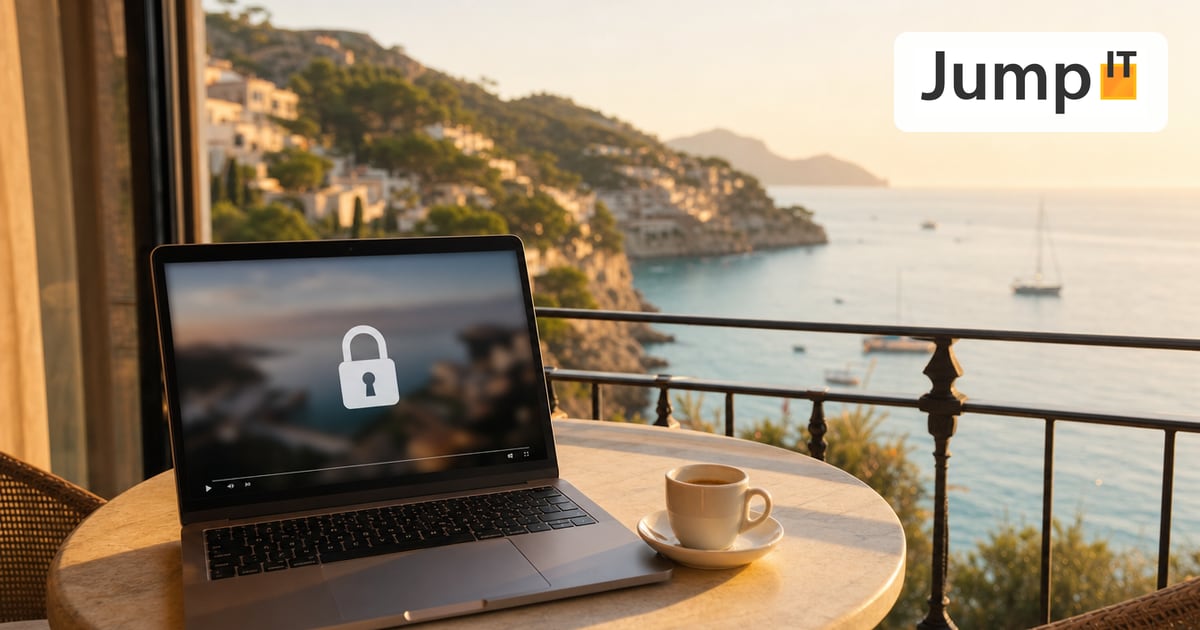
You know the feeling: you want to watch a video on YouTube, stream a series or open a website, and instead you get a message like “This video is not available in your country.” Or you book a vacation on Mallorca and notice that the same hotel website shows you a higher price than someone clicking from Germany.
That has a name: geoblocking. And there is more behind it than you might think.
What is geoblocking?
Geoblocking is a technique that website and online service operators use to detect which country you are browsing from, and then, depending on the result, show you certain content, deny it, or offer it at different prices.
How do they know where you are? Through your IP address. Every device that connects to the internet is assigned one. It gives a rough idea of your location: not your exact street, but reliable enough to tell “this is Spain” or “this is Germany”.
Why do providers do this?
Short answer: money and contracts.
Licensing rights. Netflix has the rights to a series in Germany but not in Spain, or the other way around. This is not a malicious plan against you but a leftover from the time when film studios negotiated their distribution rights country by country. The internet removed those borders technically; the law put them back up artificially.
Price discrimination. It sounds worse than it is, but that is exactly what it is. A plane ticket, a piece of software or a hotel room costs more in one country than in another because the market will bear it. Amazon, Booking.com or Microsoft do this openly. Someone browsing from Switzerland often pays more than someone browsing from Portugal. Same product, different number.
Legal requirements. Gambling sites may not be reachable at all in some countries. Political or religious content is filtered in certain states. That is not geoblocking in the classic sense, but it follows the same logic: location determines access.
An everyday example
Imagine you are on vacation on Mallorca and want to open the ARD Mediathek in the evening. Error message. The broadcaster has a license for Germany, and the public broadcasters technically only deliver their content to German IP addresses, even though you, as a viewer, pay the license fee.
Or the other way around: you live here on the island and want to access a German banking service. Many banks block logins from abroad by default as a security measure.
How does it work technically?
Providers use a few methods:
IP geolocation is the most common. Your IP is checked against a database. It is not always accurate (sometimes you end up in the wrong country or even the wrong city), but for rough country blocks it almost always does the job.
DNS-based blocks work through your internet provider. When you visit a blocked domain, you simply get no IP address back, so the site does not exist as far as your computer is concerned.
Deep Packet Inspection (DPI) is the heavy artillery. Here the internet provider looks directly into your data packets and filters by content. It is mainly used in countries with extensive internet censorship.
Can you get around geoblocking?
Yes. And in most countries that is legal too, as long as you do not break any contract terms, which is a different question.
A VPN (Virtual Private Network) is the best-known way. You connect through a server in another country, and to everyone involved it looks as if you are browsing from there. Netflix in the US then shows you the US catalog. The ARD Mediathek thinks you are in Frankfurt.
It has to be said that Netflix and co. actively fight VPN use. Many well-known VPN servers are blocked by the streaming services. It is a permanent game of cat and mouse.
Switching your DNS resolver is a simpler but more limited method. Using a different DNS server, such as Cloudflare’s 1.1.1.1 or Google’s 8.8.8.8, sometimes gets around your own provider’s DNS-based blocks. It does not help against IP geolocation, though.
Proxy servers work similarly to a VPN, but they are usually less encrypted and slower.
Is geoblocking legal?
In the EU, the so-called Geo-blocking Regulation has been in place since 2018. It prohibits online retailers from discriminating against you purely because of where you live when you buy physical goods or digital services without copyright. So you can no longer simply be redirected to the Spanish version of a website if you actually want to shop on the German one.
The regulation does not apply to streaming and copyrighted content, however. That is a deliberate exception the media industry pushed through. So ARD or Netflix are still allowed to block geographically.
What does this mean for you in practice?
If you regularly move between countries, or, like many people here on Mallorca, constantly rely on German services, you will notice geoblocking in everyday life. Sometimes a VPN is the most practical solution. Sometimes switching your DNS is enough. And sometimes you have to accept that certain licensing setups are simply no longer up to date but will stay that way for a while.
The internet is technically borderless. Geoblocking is a man-made fence, and fences can be climbed if you know how.
Do you have questions about this, or want to know how to set up a VPN for your home network? Just get in touch. JumpIT has been here for you on Mallorca for over 24 years.
More articles
 Internet Security Password Manager: Why You Need One and Why We Recommend 1Password
Why a password manager is a must even for ordinary users, how it works, and how 1Password differs from the built-in options in macOS, Windows and Google Chrome.
 Internet Security Starlink on Mallorca: Finally Fast Internet, Even at the Finca
Starlink works surprisingly well on Mallorca: fast, stable and instantly available for fincas without fiber. What to know about CGNAT and VPN.
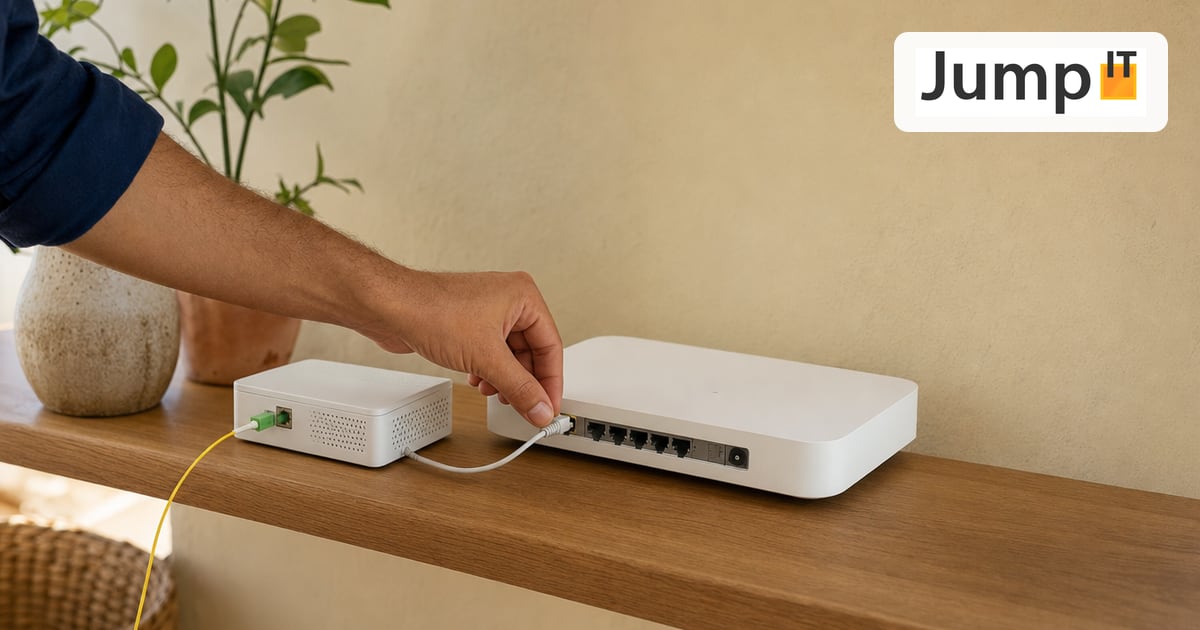 Internet Security Improving Movistar Fiber: Why Bridge Mode Often Fails
The white Movistar HGU box is unreliable to bypass with Monopuesto mode. We show how to replace it with an SFP stick or an ONT.
 Internet Security How Does IPv6 Actually Work?
IPv6 uses structured addresses, automatic configuration and direct connections without NAT. Why Dual Stack makes the switch seamless.
Note: images and parts of the text on this page were created with the help of artificial intelligence and editorially reviewed by JumpIT.
← To the knowledge center