
How Does Movistar’s Fiber Network on Mallorca Work?
An explanation for beginners: from the undersea cable to the router in your living room.
Almost every village on Mallorca is now served with fiber (Spanish “fibra óptica”). The gray box on the wooden pole, the thin black cable on the wall of the house, the small white box next to the router: it all belongs to a single system. Here we explain how it fits together.
1. What is fiber, actually?
Instead of sending electricity through copper wire, fiber sends flashes of light through a glass thread thinner than a hair. Light has three big advantages: it’s extremely fast, it hardly weakens over many kilometers, and it’s immune to thunderstorms, moisture and electrical interference, a real argument on Mallorca.
2. Where does the internet come from? The undersea cable
Mallorca is an island, so the internet comes from the mainland. Several undersea cables connect Palma with Valencia and Barcelona. Dozens of fibers run in these cables, each carrying hundreds of gigabits per second. On the mainland it continues to the big internet exchanges in Madrid, Marseille and Frankfurt.
3. The backbone on the island
From the landing station near Palma, a fiber ring runs across the whole island to the exchanges (“centrales”), one in almost every larger town, such as Llucmajor, Campos or Manacor. These buildings are the old telephone exchanges, which now house the fiber equipment.
4. The central office: the OLT
In the exchange stands the most important device of the whole chain, the OLT (Optical Line Terminal). You can think of it as a huge distributor: on one side it connects to the backbone, on the other side hundreds of fibers go out into the town’s streets. Each individual port on the OLT later serves up to 64 households.
5. The trick: one fiber for many houses (splitter)
Now comes the principle that makes fiber so affordable. Movistar does not lay a dedicated fiber to the exchange for every house. Instead, one fiber is passively split along the way, using a so-called splitter.
A splitter is a tiny glass component with no power and no electronics. It splits the light of one fiber evenly into 4, 8 or 16 outputs, like a prism. Usually it’s split twice: first 1:4 in a distribution closure in town, then once more 1:16 right at the pole. This way up to 64 households share one port on the OLT. This is called GPON (Gigabit Passive Optical Network).
“Sharing” sounds slow, but it isn’t. The fiber carries 2.5 Gbit/s to the customers and 1.25 Gbit/s back (with the newer variant XGS-PON even 10 Gbit/s in both directions). Even if all 64 households surf at the same time, each one is left with far more than a normal household needs.
6. The box on the pole: the CTO
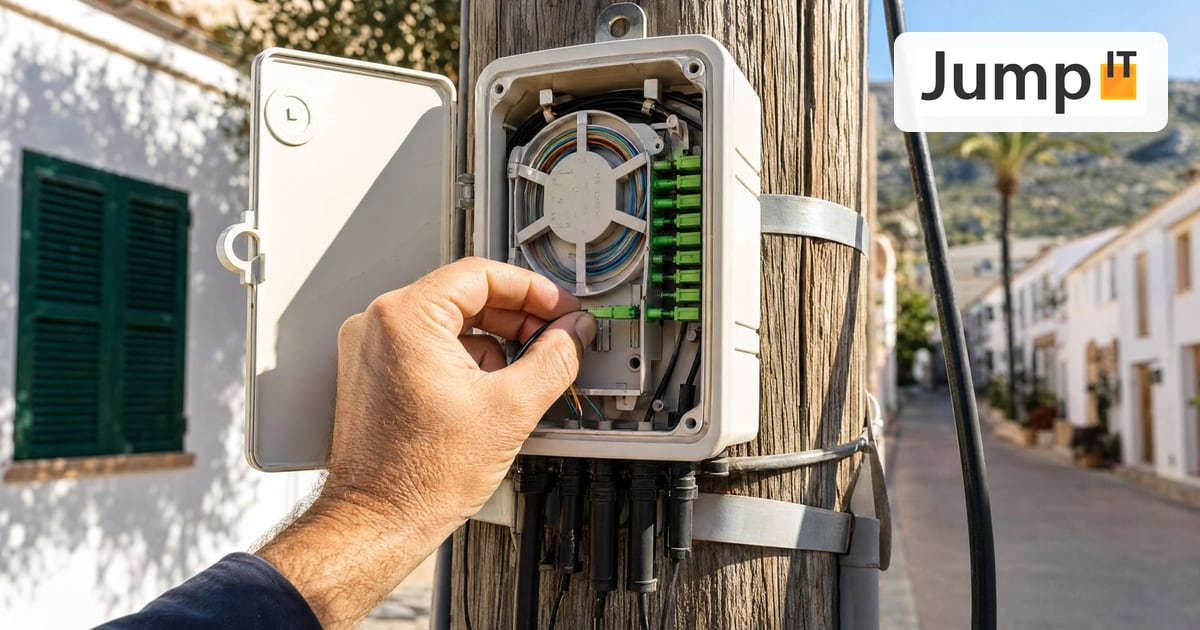
The beige box on the wooden pole is called a CTO (Caja Terminal Óptica). The last splitter sits inside it, and at the bottom of the box there are 8 or 16 ports. Each port is one house. Every CTO has a number, such as “0‑31026”; with this number the provider checks whether a port is still free at your address.
For a new installation, the technician simply plugs a pre-terminated cable into a free port. No splicing, no construction work, which is why a connection on Mallorca usually takes only an hour.
7. The cable to the house (drop) and the PTRO
From the CTO, a thin black cable with a single fiber runs to your house: the drop. On the house wall or in the hallway it ends in a small white outlet, the PTRO (Punto de Terminación de Red Óptica). Up to here the network belongs to Movistar; from here on, it’s your responsibility.
8. Inside the house: ONT and router
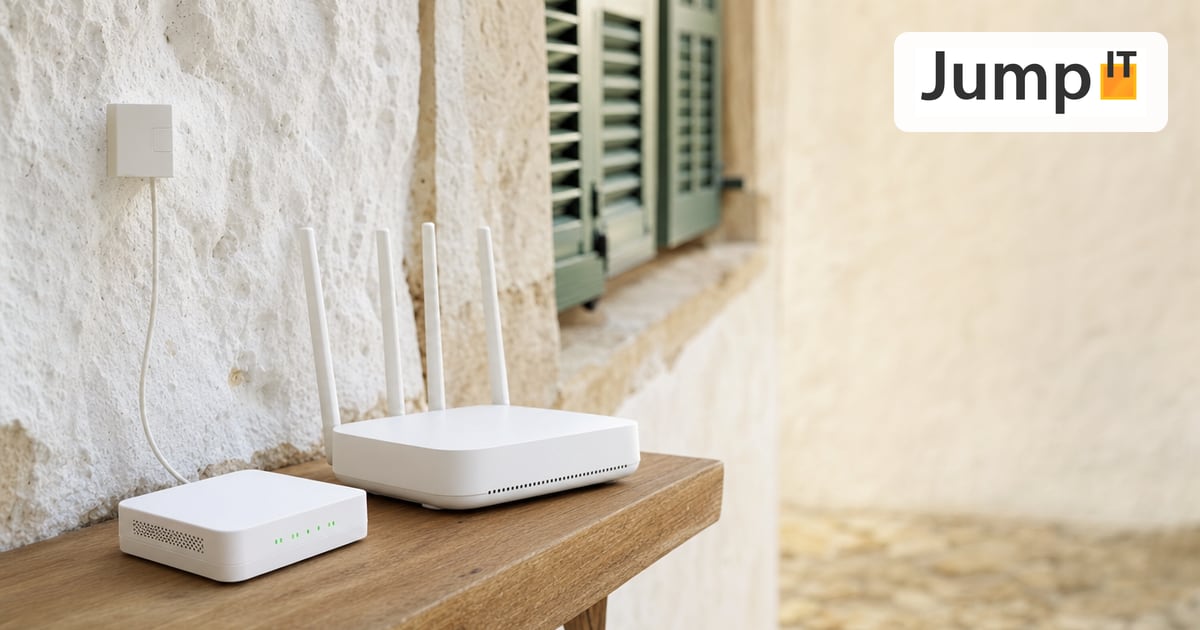
The fiber ends at the ONT (Optical Network Terminal), the small box with the green LEDs. It converts the light back into network signals. On most Movistar connections today, the ONT is built directly into the router (HGU); in the past they were two separate devices.
The router then distributes via WiFi and network cable in the house. And this is exactly where the bottleneck lies in practice: a 1 Gbit/s fiber is of little use if the standard router’s WiFi only reaches the next room. A thick stone wall, as is common on Mallorcan fincas, swallows more than the entire undersea cable.
9. Quick comparison: Spain vs. Germany
Technically, fiber is the same everywhere (GPON/XGS-PON, a worldwide standard); the difference is in the build-out:
| Spain | Germany (Telekom) | |
|---|---|---|
| Available (homes passed) | approx. 96% of households | approx. 44% |
| Actually connected | approx. 91% of those | only approx. 24% of those |
| Copper network | completely switched off in 2025 | still widespread (VDSL) |
| Network structure | one network (Movistar), others rent in | highly fragmented (Telekom, Deutsche Glasfaser, cable networks, municipal utilities) |
So Spain has not only built out earlier but also more comprehensively and uniformly. In Germany, fiber increasingly runs in the street but, unlike here, is often not ordered at all: the real bottleneck there is now the take-up rate, not the build-out itself.
(Sources: Bundesnetzagentur annual report 2025, Spanish Ministry for Digital Transformation, as of 2025.)
Frequently asked questions
Can my neighbor see my data if we share a fiber? No. Each connection gets its own key from the OLT, and the data is encrypted (AES). The neighbor’s ONT can’t decrypt your packets.
Why is my upload slower than my download? With classic GPON, all households share the return direction via time-division multiplexing. With XGS-PON plans (e.g., 10 Gbit/s symmetrical) this difference disappears.
Can Movistar check my connection remotely? Yes, partly. The OLT measures the light level of each ONT. A typical value is between −15 and −25 dBm. If it’s clearly worse, the drop cable is usually kinked or a connector is dirty.
What if the CTO is full? Then Movistar has to mount a second CTO on the pole or re-plug to a different splitter. That can take weeks, which is why it’s worth checking availability carefully before a move.
Digi, O2, Finetwork: do they use the same network? Mostly yes. Many providers rent Movistar fibers up to the CTO and only operate their own OLTs or even just their own routers. The technology on the pole is identical.
What JumpIT does for you
We plan and build the network behind the PTRO: cabling in the house, professional WiFi (UniFi) for fincas with thick walls, outbuildings via wireless link, VPN and remote maintenance. And when the fiber connection itself causes problems, we measure the light level and talk to the provider for you, in Spanish.
Fiber from the pros: Router, splicing and WiFi on your property: Fiber on Mallorca
See also: Fiber Technology in Spain: Movistar, Orange, Vodafone and Regional Providers Compared
Contact: jumpit.eu · JumpIT Netzwerk Service, Llucmajor
More articles
 Networks Retrofitting Network Cable: Is It Worth It?
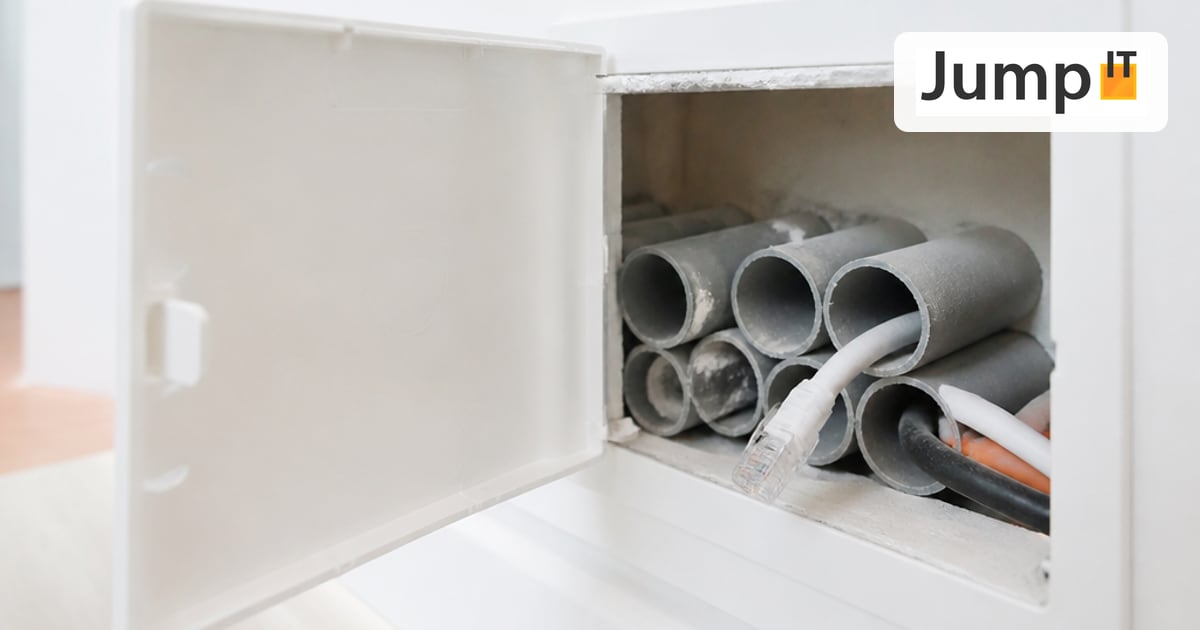
Pros and cons of retrofitting network cable, the realistic effort, and how we find existing conduits with the Kati® Blitz Ortung 2.0 without opening the wall.
 Networks Fiber Types: OM1 to OM5, OS1/OS2, G.652.D and G.657
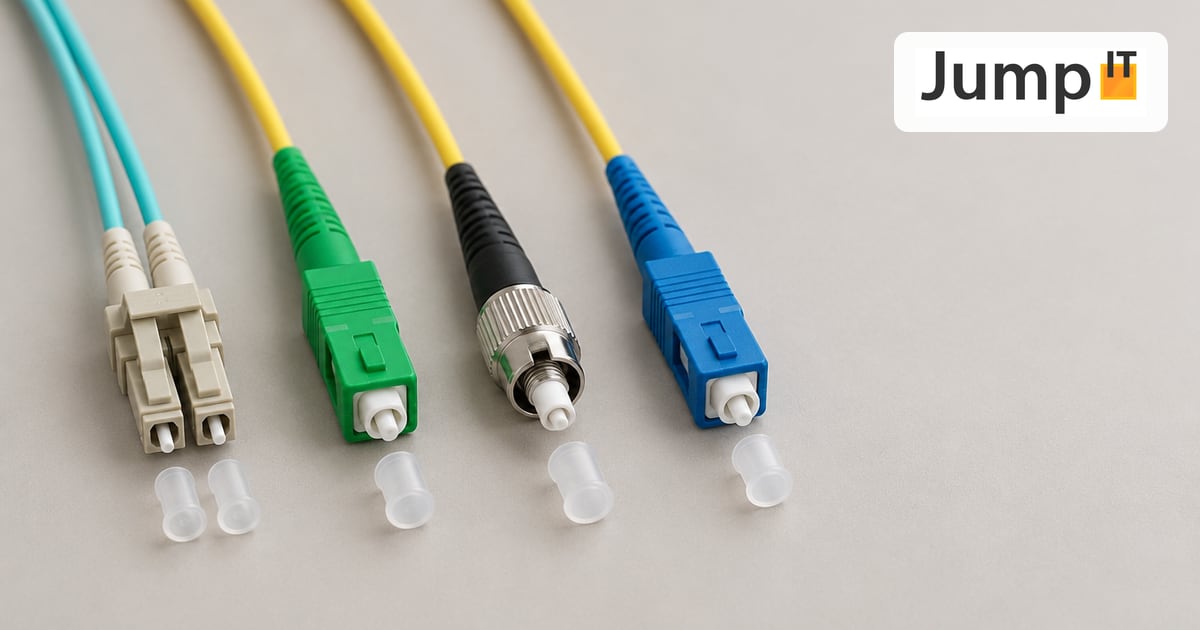
Multimode or singlemode? OM1 to OM5, OS1 and OS2, G.652.D and the bend-insensitive G.657.A1/A2 explained, with ranges, colors and an overview of SC, LC, FC, ST, E2000 and MPO connectors.
 Networks Fiber Optic Color Codes: Fiber Order Explained Simply
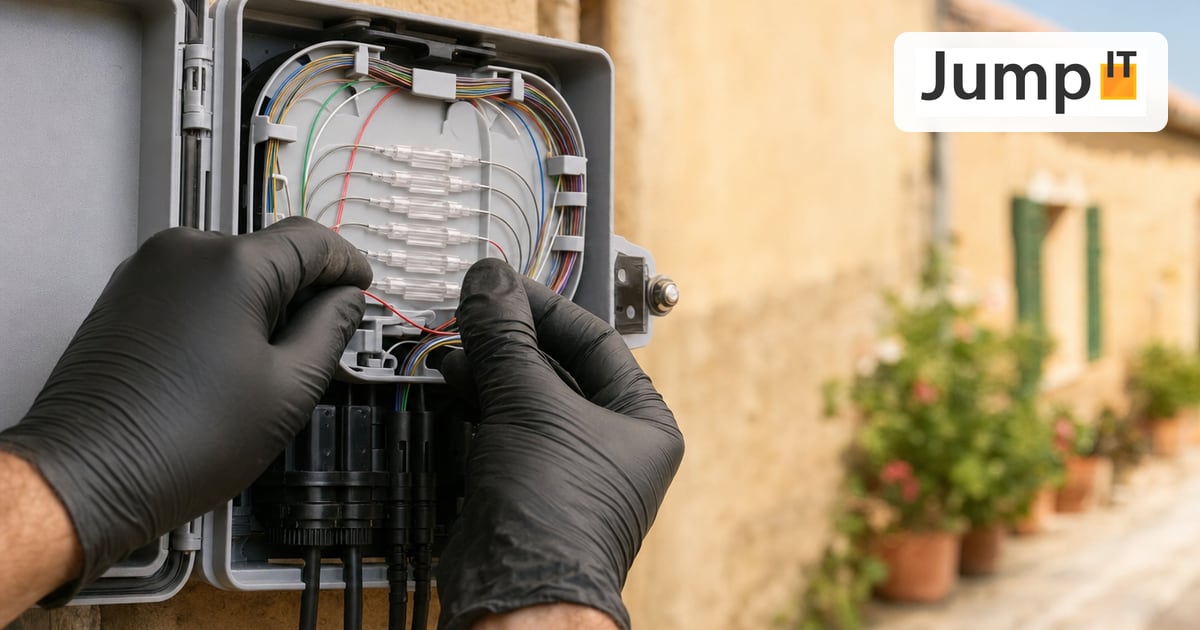
Red, green, blue or blue, orange, green? DIN/IEC 60304 vs. TIA-598 color codes, counting from fiber 13, loose tubes and connector colors, with tips for splicing and patching.
 Networks GPON and XGS-PON: What’s Behind Your Fiber Connection?
GPON or XGS-PON? How both fiber technologies work, what 1 and 10 Gbit/s really bring, which providers in Spain use what and where things stand on Mallorca.
Note: images and parts of the text on this page were created with the help of artificial intelligence and editorially reviewed by JumpIT.
← To the knowledge center